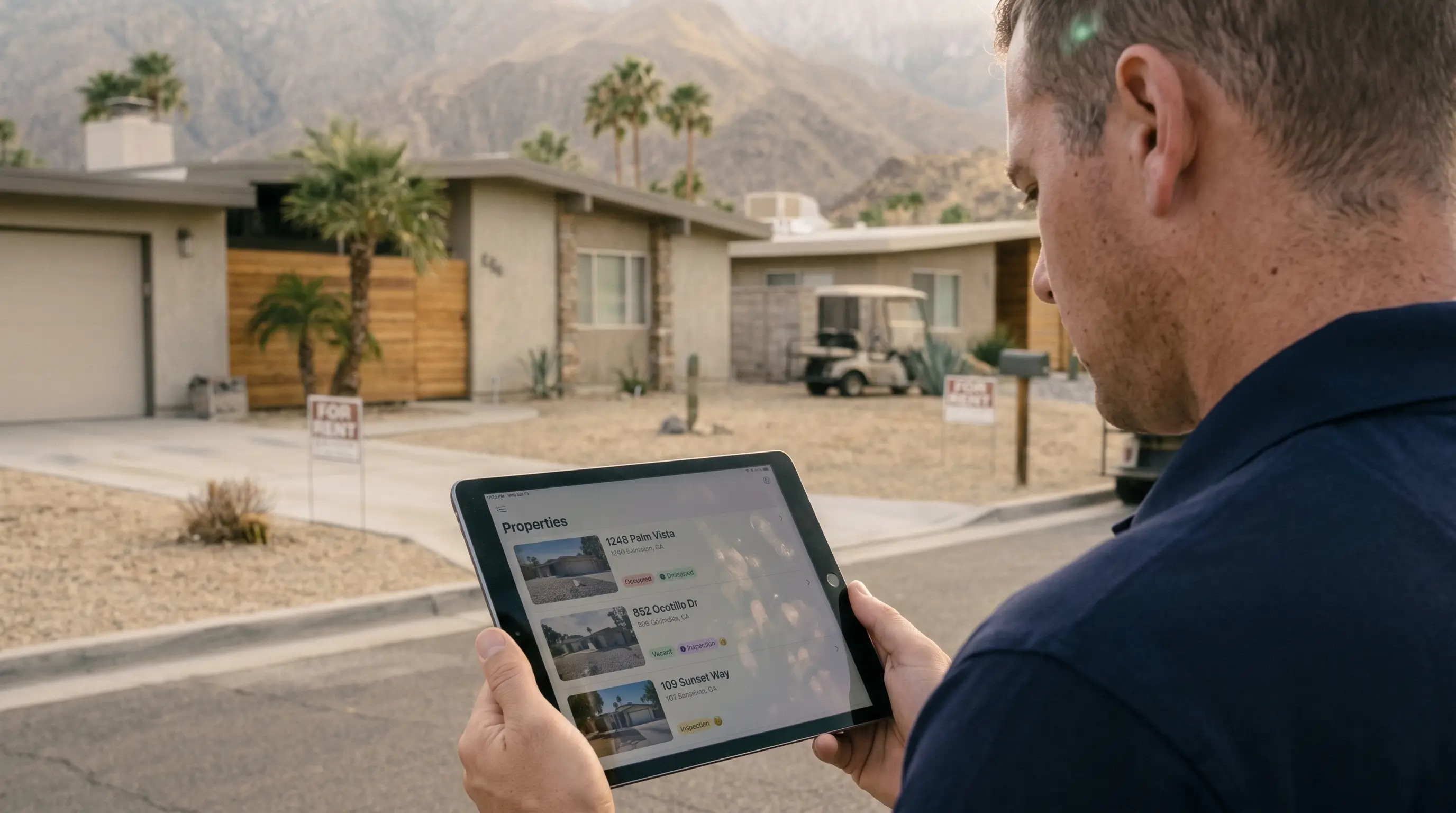
Owners who handle several Palm Springs rentals without losing sleep tend to run every property through the same maintenance, leasing, and reporting system instead of managing each one on its own.
Adding a second or third rental should scale easily since you already know how to manage one home, but different tenants, repair schedules, lease dates, and vendors quickly pull your attention in too many directions.
According to California Department of Finance population estimates, Palm Springs reached about 44,120 residents as of January 2026, keeping steady pressure on the local rental supply. That demand only pays off for owners whose operations can keep up, and this guide walks through the systems that separate a smooth portfolio from a stressful one.
Key Takeaways
- Running every property through one connected system, rather than managing each separately, is what keeps a growing portfolio from feeling disorganized.
- Standardized maintenance response times and a single rent collection system keep tenants treated consistently no matter which property they live in.
- Consolidated reporting lets you spot an underperforming property before it drags down the rest of the portfolio.
- Palm Springs’ rent registry and rent stabilization rules vary by unit count, so staying compliant is easier when you manage properties as a group.
Running Every Property Through One System
Running a portfolio well starts with treating every property as part of one operation instead of a separate project with its own rules.
Why Separate Systems Break Down Fast
Owning one rental property means managing one lease, one tenant relationship, and one maintenance calendar. Owning multiple rental properties multiplies all of that at once, which is why owners often feel behind even when nothing has gone wrong.
What Consolidation Looked Like for One of Our Clients
A client came to us after adding her third Palm Springs rental in under two years, tracking rent in separate spreadsheets with no real system behind any of it. Within a few months of consolidating her properties, she had one income dashboard, a shared vendor list, and lease renewals that no longer caught her off guard. That kind of structural change is what makes managing a larger portfolio sustainable over the long term.
Why Trust Has to Scale With Your Portfolio
When you own multiple rental properties, you need a team that reports honestly, flags problems early, and treats your portfolio like it belongs to you.
Standardizing Maintenance Across Every Property You Own
Consistency comes from standardizing your process, not personally inspecting every unit on the same schedule. Here’s how that plays out across a portfolio.
- Build one intake system. Maintenance requests rarely arrive at convenient times, and a reactive approach usually means one repair gets delayed while another jumps the line.
- Apply the same response standards everywhere. Our maintenance service coordination treats every unit the same way, so tenants in your second or third property get the same turnaround as tenants in your first.
- Share vendor dispatch and follow-up across properties. One vendor list and a consistent follow-up process keep things moving, instead of rebuilding your approach every time a new property joins the portfolio.
- Stay current on local permitting. As of June 2025, the City of Palm Springs’ rent control ordinance requires landlords to annually register their rental units and pay the associated fees, and managing properties as a group makes staying on top of that requirement much easier.
Centralized reporting is one of the biggest reliefs owners describe once it’s in place. Reviewing performance property by property hides the bigger picture, so you might see one rental doing well and assume the portfolio is healthy while a second property quietly loses money on deferred maintenance or a below-market lease.
| Reporting Style | What You See | What You Miss |
|---|---|---|
| Property by property | Individual income and expenses | Portfolio-wide trends and comparisons |
| Consolidated reporting | Combined cash flow, occupancy, and expense ratios | Nothing, since every property feeds one view |
Consolidated reports pull all of that into one view, making it possible to spot which property is dragging down returns before it becomes a bigger problem. Reviewing financial metrics that matter across your whole portfolio, rather than one address at a time, gives you a clearer read on where your money is actually going.
Our accounting and reporting process builds that view automatically, so you’re not stitching together numbers from different sources every month.
Consistent Leasing Standards Across Every Listing
Consistent leasing means every property follows the same screening standards and the same marketing approach, even if the homes look nothing alike.
- One marketing approach for every listing. A repeatable marketing strategy across all your units shortens vacancy periods and keeps one property from lagging simply because it got less attention.
- The same screening criteria for every applicant. A standardized tenant screening process reduces the chance that weaker screening on one property creates problems down the line.
- No single property setting the bar while others slip. Inconsistent leasing is one of the fastest ways a growing portfolio feels disorganized, especially when one listing attracts strong applicants, and another sits vacant.
- The same standards across your whole portfolio. We apply the same criteria to every property we manage, whether it’s your first rental or your fifth, so quality doesn’t slip as you grow.
One Rent Collection System for the Whole Portfolio
Rent collection should run through one system, not several. Here’s how to build that across a multifamily portfolio.
- Move every property onto one payment platform. When payments come in through different methods for different properties, late payments are harder to catch, and your bookkeeping gets messy fast.
- Give every tenant the same way to pay. A single, automated rent collection system applied across your whole portfolio removes that guesswork, no matter which property a tenant lives in.
- Track rent increase limits consistently across units. This matters even more under Palm Springs’ Rent Control Ordinance, which limits rent increases on covered units to 75 percent of the change in the Consumer Price Index and allows only one increase per year.
- Catch compliance gaps before they spread. Tracking those limits property by property is where many owners struggle, which is part of why managing multiple rental properties can feel disorganized, even for owners doing their best to stay on top of it.
Staying Ahead of Local Rules That Apply to Multiple Properties
Palm Springs rules vary depending on how many units you own, so it’s worth regularly reviewing your portfolio against current regulations. Across the Inland Empire, multifamily vacancy held at about 6.2 percent in the first quarter of 2025, with average rents near $2,103 per unit, according to CoStar data reported by Matthews Real Estate Investment Services.
Those numbers support a strong case for owners looking to diversify their portfolio locally, as long as each new property gets folded into the same operating system as the rest.
FAQs about Multifamily Rental Management in Palm Springs, CA
How do I know when owning another Palm Springs rental would stretch my finances too far?
Compare your cash reserves against a realistic vacancy period and unexpected repair costs for the new property. If a few months of vacancy would strain your other properties, you likely need more reserves first.
Does owning several Palm Springs rental properties make it harder to refinance or qualify for another investment loan?
Lenders look at your overall debt-to-income ratio and cash flow across all properties, not just the one you’re financing. Strong, consistent reporting across your portfolio makes qualifying for additional loans considerably easier.
How should I prepare for a large capital expense when several Palm Springs properties need major upgrades over time?
Build a reserve fund sized to your portfolio, not just one property, and schedule major upgrades in phases. Consolidated financial reporting helps you see which property needs attention first.
Can owning multiple rental properties increase my insurance costs or make coverage harder to obtain?
Yes, insurers factor in your total exposure across all properties, especially in desert climates. Bundling policies and keeping properties well maintained often helps you secure better rates despite the added coverage.
What tax issues should Palm Springs owners consider when their rental portfolio grows?
Depreciation schedules, passive activity loss limits, and 1031 exchange timing all get more complex with multiple properties. Working with a tax professional familiar with rental portfolios helps you avoid costly mistakes.
Create Consistent Standards Across Multiple Palm Springs Property
Owning multiple rental properties in Palm Springs works best when every property follows the same system for maintenance, leasing, rent collection, and reporting. That consistency is what turns a growing portfolio from a source of stress into a steady source of income.
At Coachella Valley Property Management, we build multifamily property management services specifically for owners juggling more than one property. We handle:
- Consistent maintenance coordination across every unit
- Centralized accounting and portfolio-wide reporting
- Standardized tenant screening and leasing
- Automated rent collection and compliance tracking
Your portfolio deserves better than piecemeal management. Contact Coachella Valley Property Management today to explore our multifamily services, built to run your whole portfolio like one well-oiled machine.
Related Articles
Building a Strong Rental Property Investment Portfolio in the Coachella Valley
Streamline Your Finances: Our Rent Collection and Reporting System
Estate Planning for Coachella Valley Rental Property Owners: Protecting Your Legacy